 English
 Español
 日本語
日本語

A buyer once asked us to quote a large batch of stainless steel screws for a coastal installation. The drawing simply said "stainless steel." When we asked whether 304 or 316 was intended, the response was: "Just use the good one." This is a common situation, and the cost of guessing wrong is real. If you choose 316 where 304 would do, you may spend 30–50% more than necessary. If you choose 304 where you need 316, you may face rust staining, pitting, or premature failure within a few years. The short version is this: the main difference between 304 and 316 stainless steel is that 316 contains 2–3% molybdenum, which significantly improves resistance to chlorides and salt water. For most indoor or mild outdoor applications, 304 is sufficient. For marine, coastal, or chemical-exposure environments, 316 is the safer choice. The sections below explain why, and how to decide without overspending.
The Core Difference: Molybdenum and Chemical Composition
Both 304 and 316 are austenitic stainless steels with chromium and nickel as the primary alloying elements. The decisive difference is molybdenum. Grade 316 adds 2–3% molybdenum, which strengthens the protective oxide layer and helps it self-repair when exposed to chlorides. Grade 304 has no molybdenum.
| Element | 304 Stainless Steel | 316 Stainless Steel |
|---|---|---|
| Chromium (Cr) | 18.0 – 20.0% | 16.0 – 18.0% |
| Nickel (Ni) | 8.0 – 10.5% | 10.0 – 14.0% |
| Molybdenum (Mo) | None | 2.0 – 3.0% |
| Carbon (C) | Max 0.08% | Max 0.08% |
| Manganese (Mn) | Max 2.0% | Max 2.0% |
| Silicon (Si) | Max 1.0% | Max 1.0% |
| Iron (Fe) | Balance | Balance |
304 is sometimes referred to as 18/8 stainless because of its approximate 18% chromium and 8% nickel composition. 316, in addition to molybdenum, typically has a higher nickel content, which further improves its stability in corrosive environments.
Corrosion Resistance: Where 316 Earns Its Premium
When we say 316 is "more corrosion resistant," what does that actually mean in practice? The difference is not about general surface rust — both grades resist that well in normal atmospheres. The real separation appears in three situations:
- Chloride exposure: Salt water, de-icing salts, bleach, and many industrial cleaners contain chlorides that attack stainless steel. Chlorides break down the protective film on 304, causing pitting that starts as tiny dark spots and grows into structural damage. 316's molybdenum makes it far more resistant to this mechanism.
- Pitting and crevice corrosion: These localized forms of corrosion occur under gaskets, in threaded joints, or under deposits where oxygen is limited. 316 has a higher Pitting Resistance Equivalent Number (PREN), meaning it can withstand higher chloride concentrations before pitting initiates.
- Acidic environments: 316 performs better in many acid and alkaline solutions, particularly those containing sulfuric, phosphoric, or acetic acids.
This is not theoretical. A manufacturer producing 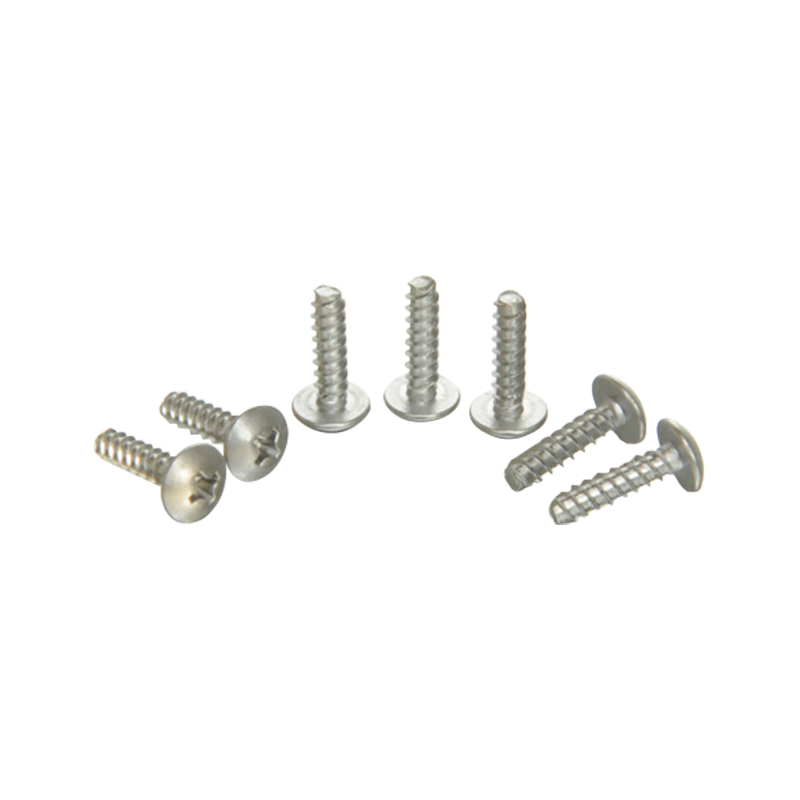 410 Stainless Steel Screw for Cost-Conscious Fastener SelectionWhen comparing stainless steel fastener grades, 410 offers a lower-cost option with good mechanical properties. Review this screw to evaluate its corrosion resistance and suitability for your specific application.View Product →for industrial customers will typically recommend 304 for general-purpose use and 316 for anything exposed to salt, chemicals, or persistent moisture.
Mechanical Properties: Closer Than You Might Think
One point often overlooked is that 304 and 316 have very similar mechanical strength. There is no meaningful "316 is stronger" advantage for standard fasteners. Both grades offer comparable tensile strength, yield strength, and hardness in the annealed condition. The table below shows typical values for reference.
| Property | 304 | 316 |
|---|---|---|
| Tensile strength (min) | 515 MPa | 515 MPa |
| Yield strength (min) | 205 MPa | 205 MPa |
| Elongation (min) | 40% | 40% |
| Hardness (max, Brinell) | 201 HB | 217 HB |
For fasteners, the practical implication is that switching from 304 to 316 does not require redesigning for different load capacity. The choice between them is almost entirely about corrosion resistance, not mechanical strength. If your application requires higher strength than either grade provides, you would look at martensitic grades like 410 stainless or consider hardened carbon steel with appropriate coating instead.
Heat Resistance: A Subtle But Real Difference
Both grades handle elevated temperatures well, but they behave differently at the extremes. 304 offers good oxidation resistance in continuous service up to about 870°C. 316 provides similar oxidation resistance but superior creep strength at high temperatures due to its molybdenum content, making it more suitable for prolonged exposure above 500°C. However, both grades lose corrosion resistance after being heated in the 450–850°C range (sensitization), where chromium carbides form at grain boundaries. For typical fasteners operating below 300°C, heat resistance is rarely a deciding factor between 304 and 316.
Cost Considerations: What the Price Premium Really Buys You
316 typically costs 30–50% more than 304, depending on global nickel and molybdenum prices. For a single bolt, the difference may be cents. For a production run of 100,000 pieces, it quickly becomes meaningful.
When buyers ask whether 316 is "worth it," we usually frame it as a risk calculation. Consider the cost of failure:
- If a fastener corrodes and the component it holds fails, what is the cost of downtime, repair, or liability?
- How often is the equipment inspected and maintained?
- Is the environment truly aggressive, or just mildly humid?
For example, a food processing line washed down with chlorinated sanitizers every day — 316 is worth the premium. A warehouse shelf inside a heated building — 304 is almost always adequate. A 410 Stainless Steel Screw for Cost-Conscious Fastener SelectionWhen comparing stainless steel fastener grades, 410 offers a lower-cost option with good mechanical properties. Review this screw to evaluate its corrosion resistance and suitability for your specific application.View Product →is one common alternative where magnetic properties or higher hardness matter more than maximum corrosion resistance.
Application Guidance: Which Grade for Which Environment?
There is no universal rule for choosing between 304 and 316, but decades of field experience give clear patterns. The table below summarizes common environments and the customary selection.
| Environment | Typical Exposure | Recommended Grade |
|---|---|---|
| Indoor dry interior | Office furniture, appliances, electronics | 304 |
| Indoor with occasional moisture | Food prep areas, wash-down zones | 304 or 316 |
| Outdoor rural or urban | Facades, signs, general construction | 304 |
| Coastal atmosphere | Within ~2 km of salt water | 316 |
| Marine immersion | Boat fittings, dock hardware | 316 |
| Chemical processing | Acids, chlorides, aggressive media | 316 |
One point worth emphasizing: 316 is not truly "marine grade" in the sense of being immune to corrosion in salt water. It is more resistant than 304, but under prolonged immersion or in stagnant conditions, even 316 can pit. For the most demanding marine environments, some specifiers turn to duplex or super-austenitic grades. But for practical engineering, 316 is the industry default for coastal and marine fastener applications.
How Manufacturers Process These Grades
From our perspective as a fastener manufacturer, both grades present different production considerations. 316 is slightly more difficult to cold-head and thread because it work-hardens faster than 304. This means tool wear is higher, thread rolling may require adjustments, and the overall production cost is slightly higher even before raw material prices are considered. Additionally, 316's higher nickel content can affect magnetic permeability. Fasteners made from either grade in the austenitic condition are typically considered non-magnetic, but cold working — such as thread rolling — can induce slight magnetism in both grades. 316 tends to remain less magnetic than 304 after equivalent cold work, which can matter in certain electronic or instrumentation applications.
Practical Selection Framework for Buyers
When you sit down with a supplier to specify stainless steel fasteners, it helps to answer the following questions in order:
1. Define the Corrosive Environment
Is the product exposed to salt water, chlorinated cleaners, industrial acids, or de-icing chemicals? If yes, classify the exposure level. Occasional splashing is far less demanding than constant immersion or trapped moisture.
2. Determine the Required Lifespan
If the assembly must last 20 years without maintenance, the additional corrosion resistance of 316 may justify the cost. If it will be disassembled, replaced, or scrapped within a few years, 304 is often the rational choice.
3. Check Compliance Requirements
Some industries — food contact surfaces, medical devices, or marine certification — mandate or strongly prefer 316. Although there is no universal legal prohibition on 304 in food contact applications, many food safety standards approve 316 specifically for acidic or high-chloride foods. Always verify which standards apply to your final product, not just the fastener itself.
4. Compare Total Cost, Not Unit Price
A 316 fastener that costs 40% more but prevents a single failure that costs thousands in downtime is obviously cheaper in the end. Evaluate the fastener cost in context of the assembled product's total value and service requirements.
Common Misconceptions Worth Debunking
Over the years, several recurring myths make their way into procurement conversations. Here are the ones we correct most often:
- "316 will never rust." No stainless steel is completely immune. 316 resists rust far better than 304, but it can still corrode in extreme conditions, especially where crevices trap stagnant salt water.
- "304 is fine for food because it is 'food grade.'" The term "food grade" is not a legal definition for stainless steel grades. 304 is widely used in food equipment, but 316 is specified where acidic or high-chloride foods are processed.
- "316 is stronger than 304." As shown, their mechanical properties are nearly identical in the annealed condition. Strength should not be the reason to upgrade to 316.
- "Non-magnetic stainless steel means it is 316. Both 304 and 316 are austenitic and largely non-magnetic in the annealed state. Cold working may make either grade slightly magnetic.
Making the Final Decision
If your project involves ordinary industrial or architectural applications without chloride exposure, choose 304 and avoid unnecessary expense. If salt, chemicals, chlorinated cleaning, or coastal conditions are part of the picture, choose 316. When in doubt, request a small test batch in both grades and expose them to your actual environment for several months. That empirical comparison is worth more than any spec sheet.
Suppliers with in-house production capability — like our factory, which manufactures fasteners to GB, DIN, ISO, and ANSI standards — can provide both grades and can usually offer meaningful guidance based on what other customers in your industry use. Regardless of which grade you select, always confirm that the supplier works with verified raw material and maintains the relevant material test certificates. The grade printed on a drawing means little if the incoming wire is not traceable.